
Table of Contents
- Full Grain vs Top Grain Leather: What's the Real Difference?
- Is Full Grain Leather Better? A Side-by-Side Comparison
- The Benefits of Full Grain Leather (and When They Matter)
- How to Identify Authentic Leather Before You Buy
- When Top Grain or Split Leather Is the Smarter Choice
- Finishing, Coatings, and the Environmental Cost of Tanning
- Frequently Asked Questions
Last Updated: September 16, 2026
Full Grain vs Top Grain Leather: What's the Real Difference?
The short answer: full grain leather keeps the hide's original surface intact, while top grain leather has that surface sanded away. That distinction drives nearly every difference in durability, appearance, and price. At Humble Drip Collection, we work with Italian tanneries and artisans who meticulously craft each piece, and the gap is wider than most shoppers expect.
To understand why, you need to know how a hide is built.
How the Hide Layers Work
An animal hide is not uniform. The top layer, the grain, holds tightly packed collagen fibers that resist tearing and abrasion. Beneath it sits the corium, a softer layer of looser fibers, then the flesh side.
Fiber density is highest at the surface and drops sharply inward, giving leather its tensile strength, flex without cracking, and breathability. The natural grain also carries the hide's imperfections, scars, insect bites, growth marks, proving the surface has not been altered.
Split leather comes from the lower layers after the grain is separated off. It has no natural grain, so manufacturers emboss a pattern and coat it heavily. Genuine leather usually means exactly this: a bonded or split product with an artificial surface.
Leather terminology and grading guidance from the Leather Working Group notes that these lower grades behave very differently under stress, which is why the grade hierarchy matters more than any marketing claim on a hangtag.
Where the Two Grades Diverge
Full grain leather is the outermost layer of the hide with the grain left untouched. Nothing is buffed, sanded, or corrected. What you see is what the animal grew.
Top grain leather starts as the same layer, but the surface is sanded or buffed to remove imperfections, creating a uniform look while removing the strongest part of the fiber structure. A top-coat, often a pigment finish, then seals and colors it.
The practical result: top grain looks more consistent out of the box, while full grain develops a patina top grain cannot replicate. Full grain also breathes better because its pores remain open; top grain's coating blocks moisture and air, protecting the surface but trapping heat.
Is Full Grain Leather Better? A Side-by-Side Comparison
For most buyers, yes: full grain leather is better where longevity and character matter, while top grain wins on price and uniformity. Neither is bad, they serve different priorities.
| Feature | Full Grain | Top Grain | Split / Genuine |
|---|---|---|---|
| Surface | Natural grain intact | Sanded and finished | Embossed artificial grain |
| Durability | Highest | Moderate | Lowest |
| Breathability | High, pores open | Low, coated | Very low |
| Patina | Develops over years | Minimal | None |
| Appearance | Unique markings | Uniform | Uniform, synthetic |
| Best for | Daily wear, long-term value | Budget, easy care | Occasional use |
Durability, Breathability, and Long-Term Value
Durability favors full grain by a wide margin. The grain layer is the densest part of the hide, so it resists scuffing and wear that would cut through a coated surface. A cared-for full grain shoe can be resoled and worn for years; top grain shows its age at the finish, not the fiber.
Breathability is the second differentiator: open pores let moisture escape, keeping feet drier and reducing odor. Coated leathers trap that moisture.
Long-term value is where the calculation gets interesting. Full grain costs more upfront but holds its appearance with simple conditioning; top grain is cheaper to replace. Wear a pair three times a week for years and full grain is the better investment; need a specific color for one season and it is not.
European Commission guidance on leather labeling and consumer information is worth reading before you buy, because labels do not always distinguish between these grades clearly.
The Benefits of Full Grain Leather (and When They Matter)
The benefits of full grain leather are durability, breathability, patina development, and grain integrity that survives years of use. They matter most for items you wear or carry daily, but whether full grain is better depends on how you will use the item, how often, and how much you care about how it ages.
How to Feel the Difference in Under a Minute
When the Benefits Do Not Justify the Price
Here is where most guides get it wrong: they present full grain as universally superior.
How to Identify Authentic Leather Before You Buy
Authentic leather can be identified by its smell, surface texture, and how it responds to pressure.
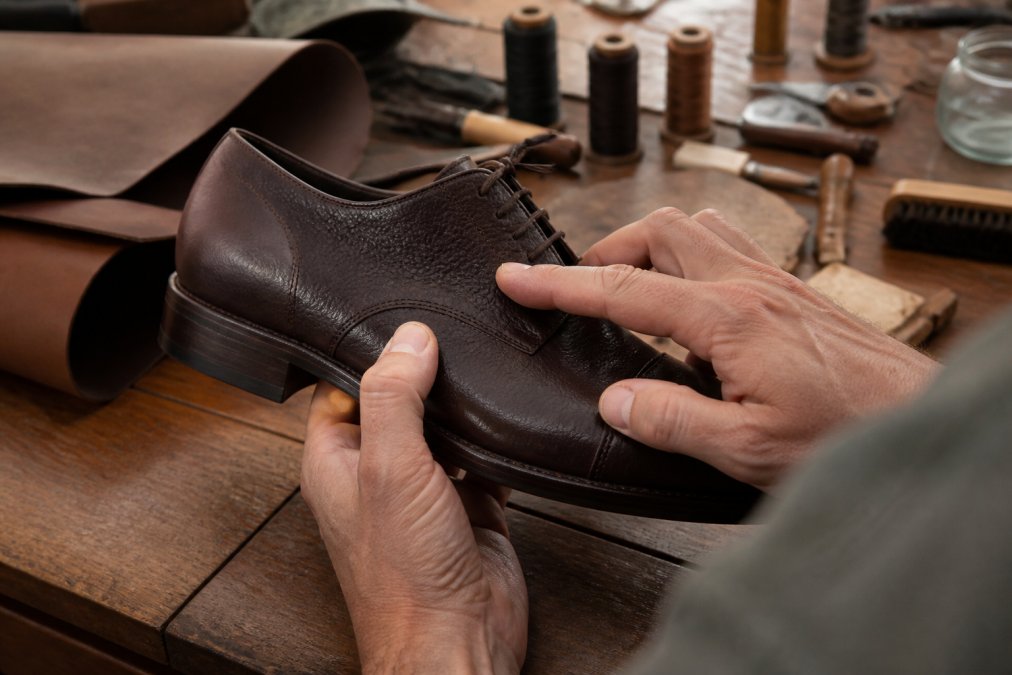
Tactile and Sensory Tests You Can Do in Person
- Press test. Push your thumb into the surface. Real leather creases into fine, irregular lines; synthetic creases in smooth, even arcs.
- Edge test. Look at a cut edge or seam. Genuine leather shows a fibrous cross-section; synthetic shows a fabric backing or a uniform plastic core.
- Warmth test. Leather warms to your touch and stays warm briefly; plastic stays room temperature.
- Moisture test. A drop of water on unfinished full grain darkens it and absorbs slowly; on a coated surface it beads and rolls off.
When Top Grain or Split Leather Is the Smarter Choice
Top grain and split leather are the smarter choice when budget, uniformity, or easy maintenance outweighs longevity.
Top Grain: The Practical Middle Ground
Consider top grain when:
- You want a consistent color across a pair or collection. Full grain varies from hide to hide, so matching a second shoe or replacement bag panel is difficult. Top grain is uniform by design.
- The item will see light, occasional use. A dress shoe worn twice a month or a handbag for special occasions will not accumulate enough wear to justify full grain's higher price and maintenance demands.
- You prefer a low-maintenance finish you can wipe clean. Top grain's coating means spills bead up and wipe away; full grain absorbs liquids and needs conditioning to stay supple.
- You need a specific seasonal color that full grain rarely offers. Bright dyes and fashion colors apply more consistently to a finished surface.
- The item will be exposed to rain, snow, or heavy sun. Top grain's protective coat resists water and UV fading better than unfinished full grain. In a wet climate, a top grain boot may hold up better than an unprotected full grain one.
Split Leather: Where It Works and Where It Fails
Split leather makes sense for:
- Book covers and linings where the surface never takes real stress
- Budget accessories like keychains, small pouches, and decorative items
- Inner structural layers of bags and shoes that are not visible
The Cost-vs-Value Calculation
A Quick Decision Framework
Ask yourself three questions before you buy:
- How often will I use this? Daily use favors full grain; occasional use favors top grain.
- How much maintenance am I willing to do? If you will not condition leather every few months, top grain's protective finish is a better fit.
- Do I care about patina and uniqueness, or do I want it to look the same in five years? Patina and character favor full grain; uniformity favors top grain.
Finishing, Coatings, and the Environmental Cost of Tanning
The finish applied to leather changes its behavior as much as the grade does.
Frequently Asked Questions
What is the lifespan of full grain leather?
Full grain leather typically lasts 10 to 20 years with regular care, and often longer on footwear that is rotated and conditioned. Because the natural grain and dense fiber structure stay intact, the surface resists cracking and scuffing far better than corrected or split leather. A well-maintained pair of full grain leather shoes can outlast three or four pairs of cheaper corrected-grain alternatives, which makes the higher upfront cost easier to justify over time.
Does full grain leather get better with age?
Yes. Full grain leather develops a patina as oils from your skin, sunlight, and natural wear build up on the surface. The color deepens, the grain softens, and small marks blend into the overall character of the piece. This is why collectors of premium leather goods prize full grain over pigmented or corrected grain, which tends to look worn rather than aged. Proper conditioning every few months keeps the patina developing evenly.
How can I tell if leather is genuinely full grain and not just marketed that way?
Look for visible natural grain with slight variations, small scars, or insect marks. These surface imperfections are a sign the top layer of the hide was left intact rather than sanded and coated. Press the leather with your thumb: full grain creases softly and springs back, while corrected grain feels stiff and plastic-like. On the inside, check for a suede-like reverse side rather than a fabric backing, which usually signals bonded or split leather.
Is full grain leather always the better choice for shoes?
Not always. Full grain leather is the better choice when you want durability, breathability, and a patina that improves with wear, which suits everyday luxury footwear and long-term investments. For high-abrasion or high-moisture environments, or for shoes that need a uniform, polished finish with minimal maintenance, top grain or a pigmented finish can be more practical. The right grade depends on how you plan to wear the piece, not on the label alone.
The real challenge is not learning the grades. It is finding a maker who will tell you which grade they used and why. Humble Drip Collection builds footwear from genuine leather, handcrafted in Italy by master artisans who blend noble tradition with a modern sensibility. Every piece is made in limited runs, so you can see and feel the grain, the stitching, and the finish before you commit. Shop now and choose a pair built to develop character rather than hide it.